Post 5
The Shrine of Health
Ahem, dear class. Welcome back, Prof. An here. I apologize that I crashed out in the end of the last lecture, but please forgive me - it hurts to burn two photocards even it’s for my lovely students.
Anyways, it’s a new day for a new start. And I am aiming to cover EACH individual shrine and their basic mechanic today, which there’re seven in total, following the update on April 20th.
The FIRST Shrine in the series is the Shrine of Health.
Let’s first look at the official introduction to the Shrine of Health:

The definition is a bit vague, hence Professor An is here to elaborate more on you.
Disclaimer: Everything BELOW is my personal experience and observation, and is NOT officially endorsed or acknowledged by the officials of Fanprose.
First of all, let’s look at the “Low Risk” bar. It is widely speculated that the BASE success rate is approximately 90% across all the Quality offered. That means, mathematically, one can have the Expectation of 9 successes in 10 Shrine of Health offerings. This makes the Shrine of Health one of the most safest and profitable Shrine in the FOUR original shrines (Health, Fame, Love and Fortune)
So, how EXACTLY does it work? We shall first recall our good old chart of the Rate of Offering:
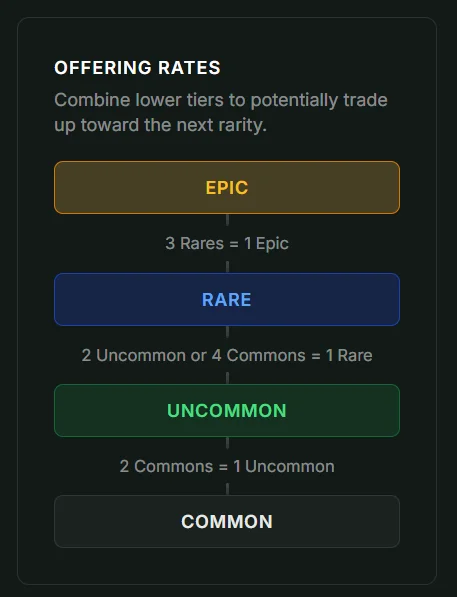
The Shrine of Health is very simple, it simply takes your cards offered, determine their rarity and Quality. And if you succeed: it is going to output ONE single card of the same Rarity as your offerings. If you fail? Wait for an hour and I wish you good luck next time.
Theorem 01:
The Rarity of your offering is uniquely determined by each card you offer.
Warning:
The Quality of your Offering ROUNDS DOWN,
That is, when it is between two tiers, it counts as the lower one.
Let’s look at a few examples that I can explain better how does everything works:
Example 1:
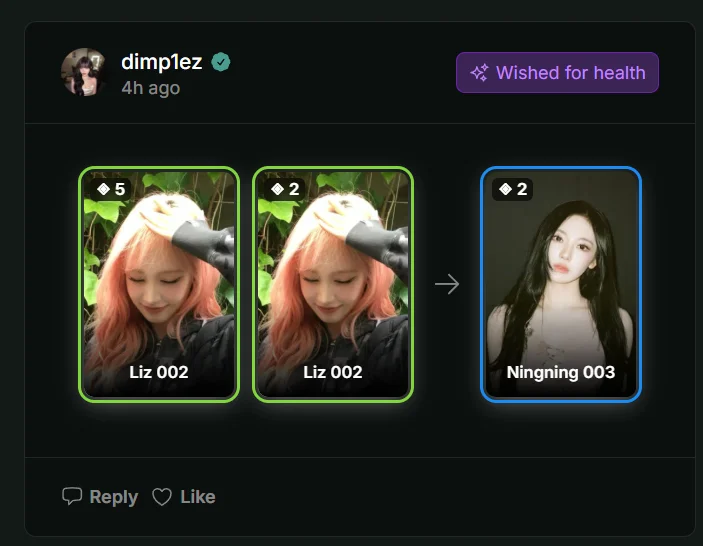
Quality of my offering: Liz 002 + Liz 002 = Uncommon + Uncommon = 2 Uncommon = 1 Rare.
Hence, the output I received was a Rare Ningning 003.
Example 2:
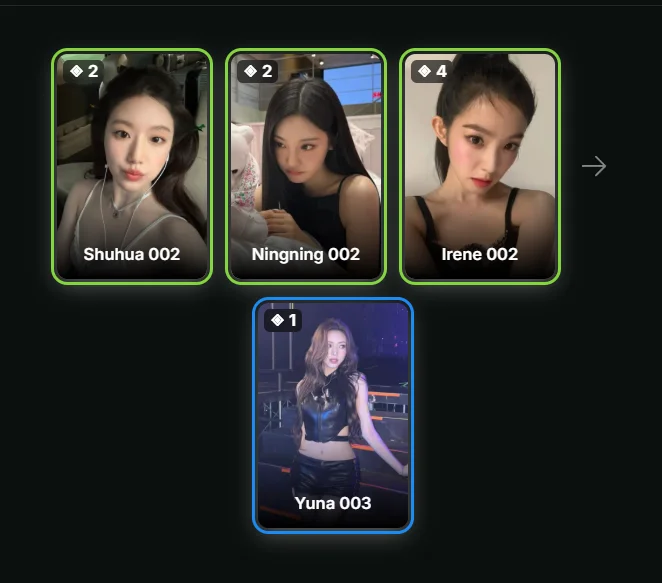
Quality of offering: Uncommon Shuhua + Uncommon Ningning + Uncommon Irene
That is 3 Uncommon = 1.5 Rare = 1 Rare (Rounded Down)
Hence the output is a Rare Yuna 003 (That means they could’ve save one card, because two uncommon cards are enough for a Rare!)
Example 3:
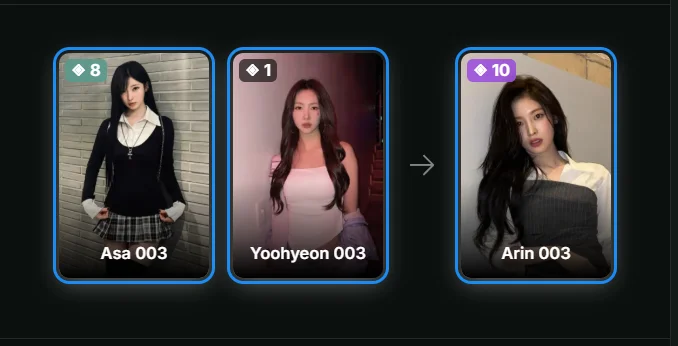
Quality of Offering: Rare Asa + Rare Yoohyeon = 2 Rare = 2/3 Epic = 1 Rare! (Rounded Down)
As we can see from above, a 2 Rare cards are NOT enough to level up into an Epic card, hence the output is a Rare Arin 003.
However, please recall from last lecture when I talked about the Quality Protection: this offering is considered as a same-tier offering because the Rarity of the output card is at the same tier as the HIGHEST tier of cards offered. Thus, the output is guaranteed to have a Quality greater or equal to 8!
This user did a great job because they can now use the Rare Arin 003 as TWO copies of Rare cards when they offer it to the next Shrine! (As introduced, Q9 and Q10 cards counts as two copies of its original tier)
Example 4:
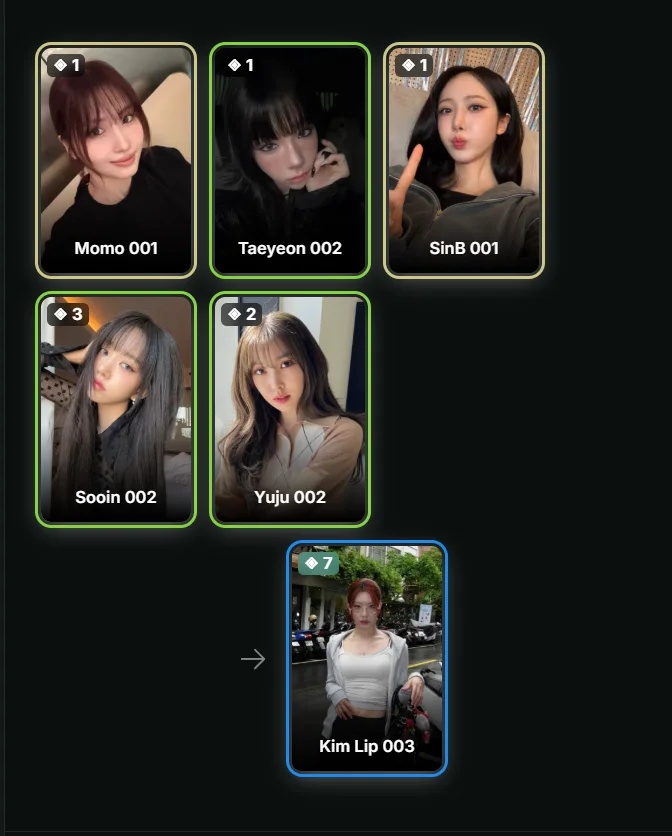
Quality of Offering: Common Momo + Common SinB + Uncommon Taeyeon + Uncommon Sooin + Uncommon Yuju
Notice that the TWO Common Cards (Momo and SinB) level up into an Uncommon.
Hence the Quality of Offering is FOUR Uncommon = 2 Rare = 2/3 Epic = 1 Rare (Rounded Down, because it is not enough for an Epic). Thus they received a Rare Kim Lip 003!
Example 5 (Quality Boost Trick):
In this case, Prof. An myself did a seemingly ODD offering: One Rare + One Common?
That’s NOT remotely close for an Epic! Why did I waste one extra card for nothing?
Well, that’s because I intentionally WANTED the following Result:
103 likes from kryphtot, baldie, mole, Sykeeeeee8, DCH, dimp1ez, Conrad888, Antares, TheReturnofTheBlueBird, AutumnyAcorn, PinkBlood, nekkonii, NakkoMinju, specialsomething18, SadMango, rvp32, Rooktrvlr, QWER, seorreality, and TripleDubu, .