Chapter 1
The Island That Would Not Let Him Leave
Ongoing
The first thing Odysseus felt was warmth.
Not the harsh, salt-stung heat of the open sea, nor the dry burning of the sun on bare rock. This was a softer heat, the kind that lived in the air itself, thick and sweet, as if the entire island breathed against his skin. He lay on his side in the white sand, cheek pressed to grains so fine they felt like powdered silk. For a long moment he did not open his eyes. He only listened.
Somewhere nearby, water lapped against the shore in a slow, steady rhythm, too gentle to be the wild waves that had smashed his ship. Birds called from high in the trees—strange birds with voices like silver bells. The wind that moved across his bare back carried the scent of flowers he had no name for, mixed with something warmer, something almost like skin.
He remembered the storm. He remembered the mast snapping. He remembered the faces of the last of his men as the water closed over them. He remembered, with a pain so sharp it made his stomach clench, the thought of Penelope waiting, of Telemachus growing taller without him. Then the memory blurred, as if the island itself had reached into his mind and gently pressed those images farther away.
Odysseus opened his eyes.
The sky above him was a perfect, endless blue, the kind of blue that never promised storms. Palm trees leaned inward over the beach like curious women. Beyond them the forest rose, dense and green and glittering with light. He pushed himself up on one elbow. His body ached in the deep, bruised way that came after days of swimming, but nothing felt broken. His tunic was gone, only a torn scrap of cloth remained around his hips. Salt had dried in white patterns across his chest and arms.
He was alone.
Or so he thought.
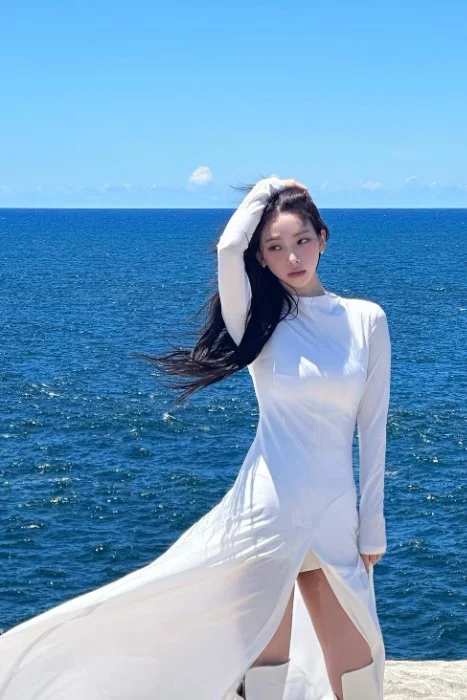
A soft sound made him turn—the faint whisper of bare feet on sand. She was already walking toward him when he saw her, and the sight of her stopped the breath in his throat.
Calypso moved as if the air itself parted for her. Her long dark hair hung loose down her back, still slightly damp, clinging in glossy strands to the curve of her shoulders and the upper swell of her breasts. The gown she wore was the color of shallow seawater under sunlight—sheer, liquid green-gold, so thin it might have been woven from mist. It clung to her as if it were wet, outlining the heavy, soft shape of her breasts, the gentle dip of her waist, the full flare of her hips. The fabric parted high on both sides with every step, revealing the long, pale length of her thighs. Shells and small pearls were braided into a thin necklace that rested against her collarbones. A single golden cuff circled her upper arm.
She was barefoot. Her skin glowed with the same warm light that filled the island.
When she stopped a few paces away from him, Odysseus could smell her—salt and honey and something deeper, like warm skin left in the sun.
“You are awake,” she said. Her voice was low, unhurried, the voice of someone who had never needed to raise it to be obeyed. “I pulled you from the water three nights ago. You slept as if the sea still held you.”
Odysseus swallowed. His throat was dry. “Where… are my men?”
Calypso’s dark eyes moved over his face, then down his body, slow and unashamed. “The sea keeps what it takes. You alone reached my shore.”
The words should have broken him. Instead they settled into the strange softness of the air and became almost bearable. He looked past her toward the horizon. The water was calm, a sheet of polished turquoise. No wreckage. No bodies. No sign that any other living soul had ever tried to leave this place.
“I must go,” he said. The words felt heavy, as if he spoke them underwater. “My home—”
“Ithaca.” Calypso finished the name for him, tasting it. She stepped closer. The sheer gown whispered against her thighs. “I know of Ithaca. I know of the wife who waits, and the son who has grown while you wandered. I have watched you for a long time, Odysseus of many turns.”
She knelt in the sand in front of him. The movement caused the neckline of her gown to slip further, revealing the soft, heavy inner curve of one breast. She did not adjust it. Her hand—warm, smooth, the hand of a goddess who had never known rough work—rose and brushed a crust of salt from his cheekbone.
“You have suffered enough,” she said quietly. “The sea has taken everything from you but your life. Stay here, and it will take nothing more.”
Odysseus caught her wrist without thinking. Her pulse beat steady and strong under his fingers. “I cannot. Penelope—”
“Penelope is a mortal woman.” Calypso’s voice remained gentle, but something ancient moved behind her eyes. “She will age. She will die. You will watch it happen if you return. Here, time does not touch us the same way. Here, you will never watch the people you love turn to dust.”
She leaned forward. Her hair fell around them like a dark curtain. The scent of her filled his lungs. Her free hand settled on his bare chest, palm flat over his heart.
“I have been alone on this island since the gods first shaped it,” she murmured. “I have waited for a man worth keeping. The others who washed ashore were soft, or cruel, or simply boring. You are none of those things. You are tired, and clever, and still beautiful even after all the sea has done to you. Stay with me, Odysseus. Let me make the years kind.”
Her thumb stroked slowly across his collarbone. The touch was light, but it sent a slow, liquid heat down his spine. He could feel the warmth of her body through the thin gown. He could see the way her breasts rose and fell with each calm breath. He could see the faint shadow of her nipples against the green-gold fabric.
He should have stood. He should have walked into the trees and begun searching for a way to build a raft. Instead he remained on his knees in the sand, her hand over his heart, her eyes holding his.
Calypso smiled—small, knowing, almost tender.
“Come,” she said. “You are still weak. Let me care for you.”
She rose and held out her hand. After a long moment, Odysseus took it.
Her fingers closed around his with gentle strength. She led him away from the open beach, into the shade of the palm trees and then deeper, along a path that seemed to open for her alone. Flowers brushed his legs as he walked. The air grew warmer, thicker, filled with the scent of ripening fruit and the faint musk of her skin. Birds with feathers like polished metal watched them from the branches and did not fly away.
They walked for what felt like a long time and no time at all. Odysseus’s body still ached, but the pain had become distant, muffled by the island’s strange softness. Every time he tried to summon Penelope’s face, Calypso’s thumb stroked the inside of his wrist, and the image blurred.
At last the trees opened into a wide clearing. A cave mouth stood against a low cliff, its entrance framed by grapevines heavy with dark fruit. Soft moss carpeted the ground. Inside, the cave opened into a high, airy chamber lit by openings in the rock that let shafts of golden light fall across the floor. There were low couches draped in fabrics the color of the sea. There were tables of polished wood laden with fruit, bread, and pitchers of wine so dark it was almost black. At the far end, a wide bed stood on a platform of smooth stone, covered in layers of soft cloth and pale furs.
Calypso released his hand and moved to one of the tables. She poured wine into a shallow cup and brought it to him.
“Drink,” she said. “It will restore you.”
Odysseus hesitated. Stories of Circe’s cup flashed through his mind. Calypso saw the thought and smiled again.
“I am not she,” she said. “I do not need to change your shape to keep you. I only need to offer what you already want.”
He took the cup. The wine was cool and rich and tasted of sun-warmed grapes and something darker, like the memory of a kiss. Heat spread through his chest as he drank. When he lowered the cup, Calypso was closer than before.
She reached up and pushed the torn scrap of cloth from his hips. It fell to the moss without a sound. Her eyes moved over him openly—his broad chest, the scars, the lean muscle of a man who had fought and swam and suffered. There was no shame in her gaze. Only quiet hunger, and something that looked almost like relief.
“You are more beautiful than I remembered,” she said.
Her hands rose and rested on his waist. Her thumbs stroked the deep cut of muscle there. Odysseus’s breath left him in a slow exhale. He should have stepped back. Instead his own hands lifted, almost against his will, and settled on the soft curve of her hips. The sheer fabric of her gown was warm from her skin. Through it he could feel the full, giving flesh beneath.
Calypso tilted her face up. Her mouth was only a breath away from his.
“Stay,” she whispered. “Just for a little while. Let me wash the salt from you. Let me remind your body what it is to be wanted without having to fight for it.”
Her lips brushed the corner of his mouth. Not quite a kiss. A promise of one.
Odysseus closed his eyes. In the darkness behind his lids he saw Ithaca—the rocky cliffs, the olive tree, Penelope’s hands weaving at her loom. The images felt far away, as if he looked at them through deep water. When he opened his eyes again, all he saw was Calypso’s face, and the soft, endless invitation in her gaze.
She took the empty cup from his hand and set it aside. Then she stepped back, just far enough to reach up and push the sea-green gown from her shoulders.
The fabric slid down her body like water. It caught for a moment on the full curve of her breasts, then fell free, pooling at her feet. She stood before him naked except for the pearl necklace and the golden arm cuff. Her breasts were heavy and soft, the nipples a dark rose against pale skin. Her waist dipped in sharply before flaring into full hips and the dark thatch of hair between her thighs. Her legs were long and smooth. She made no move to cover herself. She simply watched him look.
“This is what I offer,” she said quietly. “Not a night. Not a season. All the nights that remain in the world, if you want them. My body. My bed. My voice in your ear when you wake. No more storms. No more hunger. No more watching the people you love die while you still live.”
She closed the small distance between them. Her bare breasts pressed against his chest. The soft weight of them, the warmth of her skin, the way her nipples hardened against him—it all crashed through the last of his resistance like a wave against a failing seawall.
Odysseus’s hands slid up her back, feeling the smooth dip of her spine, the soft flare of her waist. He buried his face in the curve of her neck and breathed her in. Salt and honey and warm woman.
Calypso’s arms wrapped around him. One hand stroked the back of his head. The other slid down to rest on the curve of his ass, pulling him more firmly against her.