Part 6
Lolla Coaster
Ongoing
You stood near the edge of the T-Mobile Stage crowd long after I-DLE had left the stage on Friday, July 31. The sun was still high, the air thick with dust and the leftover heat of four thousand bodies pressed together. Your headset hung loose around your neck. The members had already been escorted back toward the artist compound—Soyeon still talking logistics with the stage manager, Minnie laughing about something with a dancer, Miyeon and Shuhua sharing a water bottle. Yuqi had caught your eye just before she disappeared behind the black curtains. She had given you that familiar half-smile, the one that said she knew you were still watching, then disappeared into the shade.
You could have left. Most managers would have. The set was done, the livestream clips were already circulating, the post-show reports were filed. But something in the Chicago air kept you rooted. The festival still had three full days left. You told the rest of the team to head back to the hotel without you. You would stay. You wanted to see what the rest of Lollapalooza looked like when you were not responsible for anyone.
Saturday blurred past in a haze of stages and sets you only half watched. You moved through the crowds like a ghost, headset off, badge tucked under your shirt so no one from Cube would flag you down. By the time Sunday arrived you had already decided. You would stay for the final night. Specifically, you would stay for the Allianz Stage at 7:45 p.m.
You arrived early. The field in front of the Allianz Stage was already thickening. People who had been there for earlier acts refused to give up their spots. Others drifted over in groups, some carrying lightsticks that glowed soft pink and blue under the growing dusk. The sun had dropped behind the skyline. The air cooled just enough to make the residual heat of the day feel heavy instead of sharp. You found a place slightly off-center, far enough back that you could see the full width of the stage but close enough that the faces on the monitors would still be clear.
The house lights dropped at exactly 7:45.
A low roar rolled across the field, the kind that starts in the front rows and spreads backward like a wave. The LED screens on either side of the stage flared to life with abstract graphics—sharp lines of white and violet, geometric patterns that pulsed once and then settled. Behind the screens the silhouettes of a live band took their places. Drums. Two guitars. Bass. Keys. A small cluster of backup dancers moved into position at the edges.
Then the four members of aespa walked out.
No long spoken introduction. No dramatic pause. They simply appeared under a sudden wash of cool white light, and the opening notes of “Black Mamba” hit the speakers with a weight that made the ground under your feet vibrate.
You had watched the group before, of course. Everyone in the industry had. But watching them from the middle of a festival field at night was different. The sound was louder, the lights more aggressive, the crowd denser. And standing slightly taller than the other three, moving with a precision that somehow still looked effortless, was Karina.
Her long black hair was down, slightly wavy from the humidity, catching every flash of light. She wore a black crop top with long white fringe straps that hung over her chest like soft ropes, a white band sitting tight under her bust, and tiny black leather-look shorts with side lace-ups and more fringe that swung every time she stepped. The outfit left almost nothing to the imagination and somehow still looked intentional, designed for movement rather than pure exposure. Under the stage lights her skin already held a faint sheen. When she lifted the microphone for the first line her voice cut clean through the mix—steady, clear, with that slight edge that made every syllable land.
The choreography was surgical. Formations snapped into place with the kind of timing that only comes from years of drilling the same numbers until the body no longer needs to think. Karina took the center more often than not. When the first heavy dance break hit, the fringe on her top and shorts moved with her, drawing the eye to every sharp isolation of her shoulders, every roll of her hips, every clean extension of her long legs. The crowd responded instantly. Phones rose in a scattered forest of glowing screens. Someone near you shouted her name. Someone else just screamed.
You watched the way her body worked under the lights. The white fringe straps framed the soft full shape of her breasts, the fabric stretching just enough with every breath and every sharp movement to remind you they were real, heavy enough to have weight, soft enough to move. The tiny shorts sat low on her hips, the lace-ups on the sides pulling tight against the curve of her ass every time she dropped into a deeper stance. Her thighs—thick, powerful, the kind of dancer’s thighs that carried both muscle and softness—flexed and released with every step. When she turned, the fringe hanging from the shorts swung against the pale skin of her outer thighs, and the crowd’s noise spiked again.
The song ended on a hard cut. The lights shifted to a colder blue. Karina stepped forward slightly, microphone raised, and spoke for the first time.
“Chicago,” she said, voice a little breathless already, the smile visible even from where you stood. “How are you feeling tonight?”
The answering roar was immediate and loud enough to drown the monitors for a second. She laughed—short, bright, genuine—and glanced sideways at Winter, who was already moving into position for the next track. Giselle and Ningning took their places on either side. The band hit the opening of ‘Next Level,’ and the stage exploded into motion again.
You stayed locked on Karina.
She took the center of the formation for the first verse, body angled toward the left side of the crowd, then the right, making sure both ends of the field got a clear look. The choreography demanded constant precision—quick footwork, sharp arm lines, sudden drops into lower stances that made the fringe on her shorts flare outward. Every time she hit one of those drops you saw the way the leather-look fabric stretched across the round shape of her ass, the way her thighs pressed together for a split second before she exploded back upward. The stage lights caught the faint sheen of sweat already forming along her collarbones and the soft upper curve of her breasts. The white fringe swung with every movement, never quite covering, always drawing the eye back.
Between the first and second choruses she moved to the edge of the stage closest to your side of the field. For a few seconds the camera on the side LED screen locked on her face in close-up. You watched her mouth form the lyrics, the slight part of her lips, the focused intensity in her eyes that never quite lost its playful edge. When the dance break hit she dropped low again, one hand braced on her thigh, the other still holding the mic, and the entire front section of the crowd surged forward as if pulled by the same string.
The set continued without pause.
‘Armageddon’ came next, the live band giving the track a heavier, more physical low end than the studio version. The choreography grew even sharper. Karina’s sections were full of isolations—shoulders, ribs, hips—each one clean enough to see from the middle of the field. You watched the way her waist moved independently of her hips, the tiny cinch of it above the low waistband of the shorts, the soft plane of her stomach that stayed mostly still even when the rest of her body was in constant motion. The fringe on the top never stopped swinging. Every time she lifted her arms the white straps shifted across the full shape of her breasts, and the crowd’s reaction was immediate and loud.
She spoke again after the song, voice a little rougher now from the dancing and the volume.
“You guys are so loud,” she said, laughing, brushing a strand of long black hair away from her face with the back of her wrist. “We can feel it from up here. Thank you.”
Giselle said something beside her that the microphones only half caught. Karina turned her head, grinned, and answered in a quick mix of Korean and English that made the other three members laugh. Then the lights shifted again and the opening of ‘Supernova’ hit.
You barely blinked.
The track demanded constant high energy. Karina’s parts were full of fast footwork and sudden changes of direction that made the fringe on both the top and the shorts flare out in every direction. When she hit the hardest dance break she was center stage again, body angled slightly to the side, one leg extended, the line of her thigh clean and powerful under the lights. The camera on the LED screen caught the soft bounce of her breasts under the black fabric as she landed from a small jump, the way the white fringe settled back against her skin afterward. You could see the faint sheen of sweat along her sternum and the soft upper slopes. The shorts had ridden up slightly on one side; the lace-up detail dug into the curve of her hip.
The crowd was fully locked in now. People were jumping. Lightsticks waved in messy arcs. Someone near the front held up a large handmade sign with her name on it in glittering letters. Karina saw it, pointed, and gave a quick thumbs-up without breaking the choreography. The section of the field around the sign screamed even louder.
‘Whiplash’ followed, then a stretch of newer material from the LEMONADE era. The live band stayed locked in. The dancers filled the spaces between the members without ever crowding them. Through every transition Karina remained the clearest focal point—tallest, sharpest, the one the cameras found most often. You watched the way her long hair moved when she whipped her head on certain counts, the way the strands stuck slightly to the damp skin of her neck and shoulders. You watched the controlled power in her legs every time she dropped into a deeper plié, the soft thick muscle of her thighs flexing, the fringe of the shorts swinging against pale skin.
Mid-set she stepped forward alone for a brief ment while the others caught their breath and the band played a low holding pattern.
“This is our first time at Lollapalooza,” she said, voice warm and a little breathless. The smile she gave the crowd was wide and real. “We prepared a lot for you. I hope you’re having fun with us tonight.”
The answering roar was immediate. She laughed again, the sound bright even through the festival speakers, and added, “We’ll keep going. Don’t get tired before we do.”
Then the lights dropped for a half-second and the opening of ‘Switchblade’ hit.
The crowd’s reaction was physical. A surge of bodies toward the stage. A wall of sound. Ty Dolla $ign walked out from the side, and the two of them fell into the track as if they had rehearsed it a hundred times. Karina’s choreography adjusted around the guest without losing any of its precision. She stayed close enough that the chemistry read clearly even from the middle of the field—easy, playful, confident. When the dance break arrived she took the center again, body moving in sharp isolations while the fringe on her outfit turned every motion into something almost hypnotic. The side LED screen caught a close-up of her face for several seconds: eyes focused, lips parted around the lyrics, a faint flush high on her cheeks from the heat and the effort.
You did not look away.
The final stretch of the set was relentless. ‘Hold On Tight.’ ‘Lemonade.’ A last high-energy number that sent the entire field into motion. Karina remained the clearest point of focus through all of it. You watched the way her body worked under the lights—the soft full shape of her breasts moving inside the black crop with every sharp breath and every hard count, the tiny waist staying tight and controlled, the round curve of her ass filling the shorts completely every time she turned or dropped, the powerful thick thighs carrying her through every demanding section without visible fatigue. Sweat had darkened the fabric slightly at her lower back and along the underband of the top. Strands of long black hair clung to her neck and the side of her face. The body glitter or highlighter on her collarbones and the upper slopes of her chest caught every flash of light and threw it back.
When the final note hit, the stage lights flared bright white for a long second and then dropped to a lower wash. The four members stood together at the center, breathing hard, smiling. Karina lifted the microphone one last time.
“Thank you, Chicago,” she said, voice rough now but still clear. “Thank you for tonight. We love you. Please get home safe.”
She glanced toward the band and the dancers, then added a quick, genuine “Thank you to our band, our dancers, everyone who worked so hard for this stage.” The other members echoed her. They bowed together. The crowd’s noise rose one final time and held.
You stayed where you were as the house lights began to come up and the field slowly started to shift. Around you people were already talking, comparing favorite moments, replaying clips on their phones. The residual heat of the performance still hung in the air. On the stage the crew had already begun the changeover, but for a few more seconds the image of Karina under those lights stayed fixed in your mind—long black hair, white fringe swinging, body moving with that precise, powerful, unapologetically physical grace, the soft full curves of her chest and the thick strength of her thighs and the tight round shape of her ass all working together under the festival lights while thousands of people watched.
You exhaled slowly.
You left the Allianz Stage while the crowd was still thinning. The walk back through Grant Park felt longer than it should have. The grass was trampled and damp in places. Distant bass from the remaining late sets still pulsed through the air. Your badge got you through the artist exit without trouble. A festival car was waiting; you took it without speaking much to the driver. The city lights slid past the windows in long streaks of white and red.
The hotel was one of the higher ones along the river, the kind Cube always booked when the schedule ran long. The lobby was quiet at this hour. A few other industry people moved through in small groups, still wearing lanyards or half-zipped hoodies. You kept your head down, nodded once at the night desk, and took the elevator alone.
Your floor was high enough that the hallway stayed silent. The keycard clicked. The door opened inward on soft carpet and the low hum of the air conditioner.
You expected empty space. The usual: your suitcase open on the luggage rack, the black hoodie you had thrown over a chair that morning, the half-finished bottle of water on the desk, the city glittering beyond the floor-to-ceiling windows.
Instead, the first thing you saw was the short black bob.
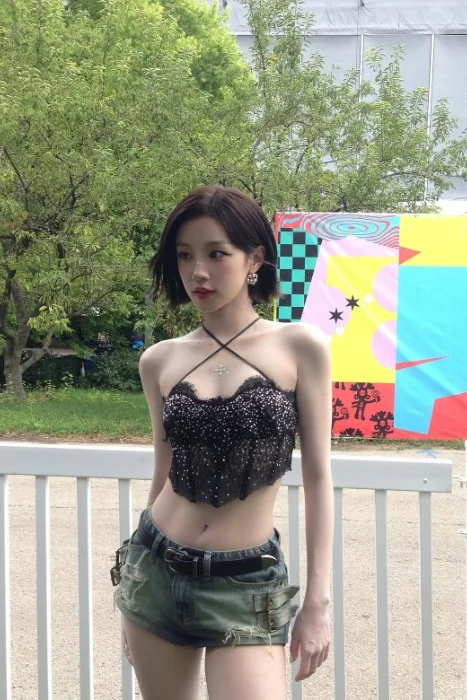
Yuqi was sitting on the edge of the wide bed, one leg folded under her, the other dangling. She still wore the same black sequined lace crop top from earlier in the day—the one with the crisscross straps that left her back almost completely bare and the soft upper curves of her chest framed by the sparkling fabric. The low-rise denim shorts sat exactly where they had on the grass outside the stage, the black belt still threaded through the loops. A light dusting of body glitter still clung to her collarbones and the top of her sternum, catching the warm lamp light. Her pale skin looked even smoother indoors. The small tattoo on her left shoulder blade was visible every time she shifted.
She looked up the moment the door opened. Her expression was already half a smile, the familiar one that always sat somewhere between mischief and quiet challenge.
“You’re late,” she said. Her voice was lower than usual, a little rough from the set two days ago and whatever she had been doing since. The Chinese accent that sometimes slipped into her Korean when she was tired or teasing was there, soft around the edges. “I thought managers were supposed to keep better schedules.”
You let the door close behind you. The lock clicked automatically. For a second you only stood there, still holding the keycard, the residual heat of the festival still clinging to your clothes.
“How did you get in?”
Yuqi tipped her head. The short black hair moved with the motion. “I asked the front desk for a spare. Told them I was your artist and I left something in the room.” She shrugged one shoulder. The sequined top shifted, the lace edge brushing the soft swell of her breast. “They didn’t ask many questions. I smiled.”